dB vs dBm: what absolute power and relative loss really mean
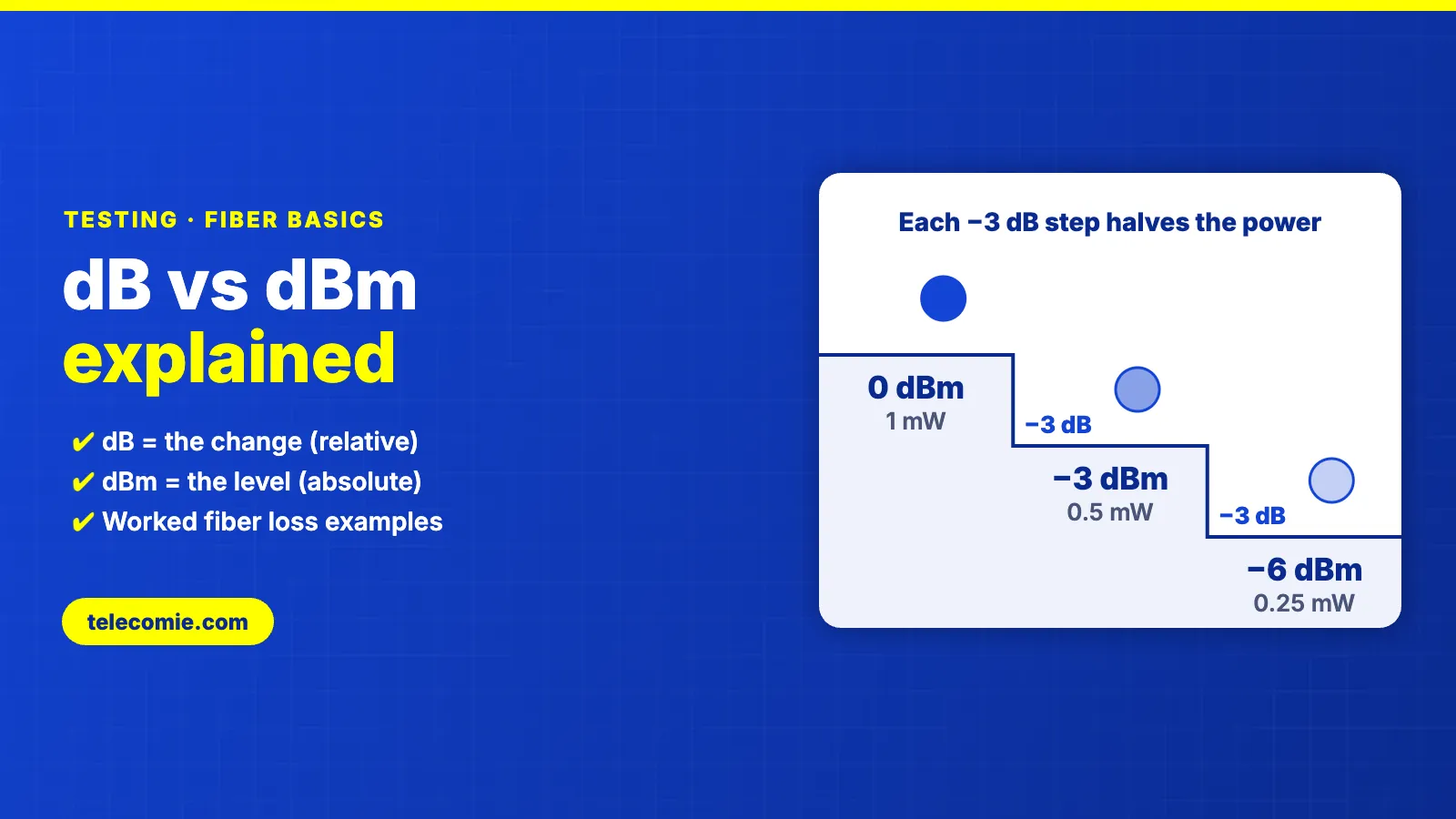
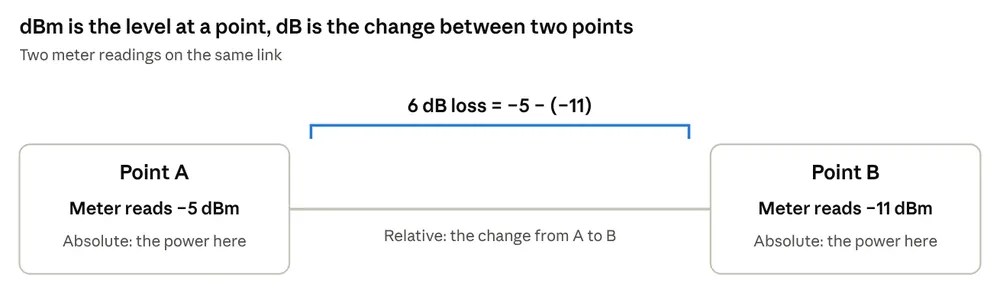
Here is the short answer. dBm tells you how much power you have. It is an absolute power level, measured against one fixed amount: 1 milliwatt (mW). dB tells you how much the power went up or down. It is a relative change, like a loss or a gain. An optical power meter shows dBm. The loss of a fiber link is given in dB. Subtract one dBm reading from another and the answer is the loss in dB.
Key points
- dBm = how much power is here, compared with 1 mW. 0 dBm means exactly 1 mW.
- dB = how much the power changed between two points. It has no fixed starting point.
- dBm minus dBm gives dB. dBm minus dB gives a new dBm. Never add two dBm numbers together.
- Easy rules to remember: lose 3 dB and half the power is gone. Lose 10 dB and only a tenth is left.
Watch: dB vs dBm in 60 seconds
The basics in two pictures
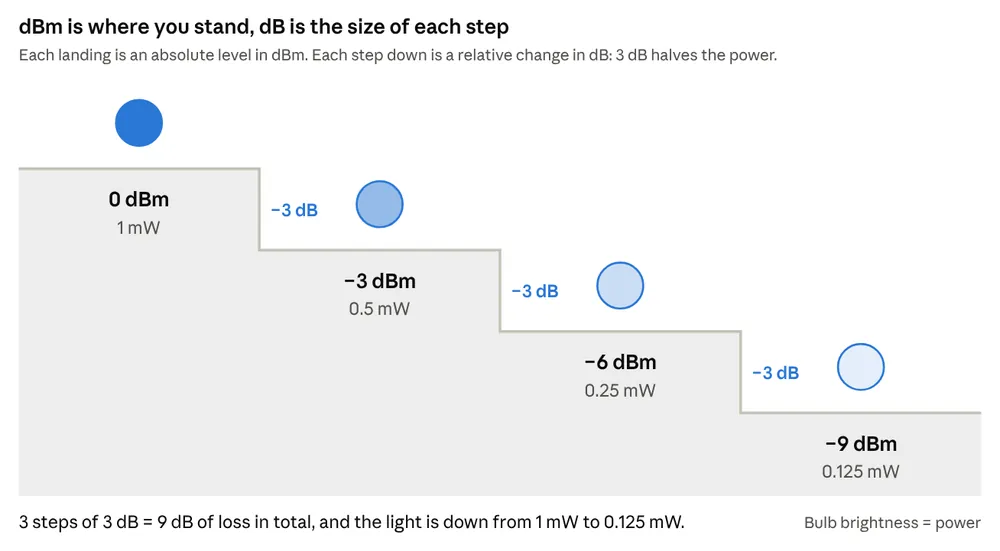
Picture a staircase. The landing you stand on is like dBm: it says exactly how high you are, measured from one fixed spot (1 mW). Each step down is like dB: it only says how far you went down, not where you started. That is the whole difference between absolute and relative.
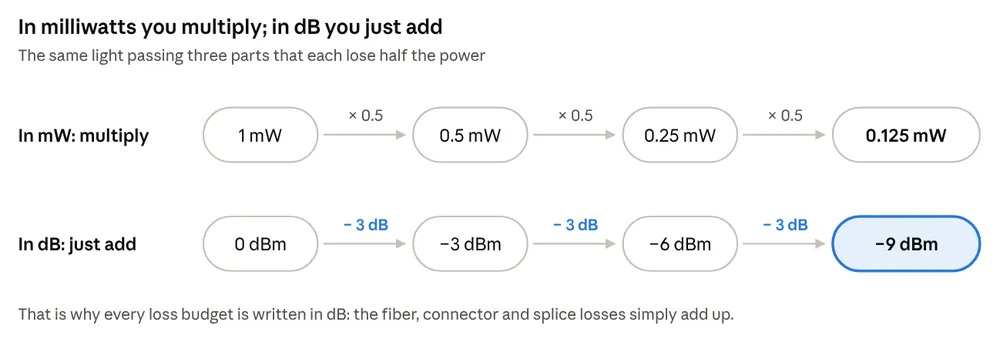
Why do engineers use dB at all? When light goes through a cable, a connector and a splice, each one takes away a share of the power. In milliwatts you would have to multiply fractions. In dB you just add up the losses, which is much easier.
What is a decibel? The decibel formula, step by step
A decibel (dB) is a way to compare two powers. The decibel formula is dB = 10 × log10(power out ÷ power in). It looks scary, but it is built in three simple steps.
Step 1: compare the two powers. Divide the power coming out by the power going in. If 1 mW goes in and 0.5 mW comes out, the answer is 0.5. That means half the power made it through.
Step 2: take the log. A logarithm (log) answers one question: “10 to what power gives this number?” For 100 the answer is 2, because 10 × 10 = 100. For 1,000 it is 3. Early telephone engineers called this number a bel, after Alexander Graham Bell. Logs are handy because they turn big multiplications into small additions.

bels = log10(P out ÷ P in)
Step 3: multiply by 10. A bel is too big for everyday use, a bit like measuring a pencil in meters. So we count in tenths of a bel, called deci-bels. That is why the decibel formula has a 10 in front.
dB = 10 × log10(P out ÷ P in)
Worked example. 1 mW goes in and 0.5 mW comes out. The ratio is 0.5. The log of 0.5 is −0.301. Multiply by 10 and you get −3.01 dB. The minus sign just means power was lost. On a test sheet we usually write it as a loss of 3.01 dB.

Going backwards: from dB to a power ratio. Divide the dB number by 10, then raise 10 to that power.
P out ÷ P in = 10^(dB ÷ 10)
Example: a 6 dB loss gives 10^(−0.6) = 0.251. So about a quarter of the light reaches the far end.

Two rules are worth learning by heart: every 3 dB of loss cuts the power in half, and every 10 dB of loss leaves only a tenth. (3 dB is really 3.01 dB, so the halving rule is very close but not perfect.)
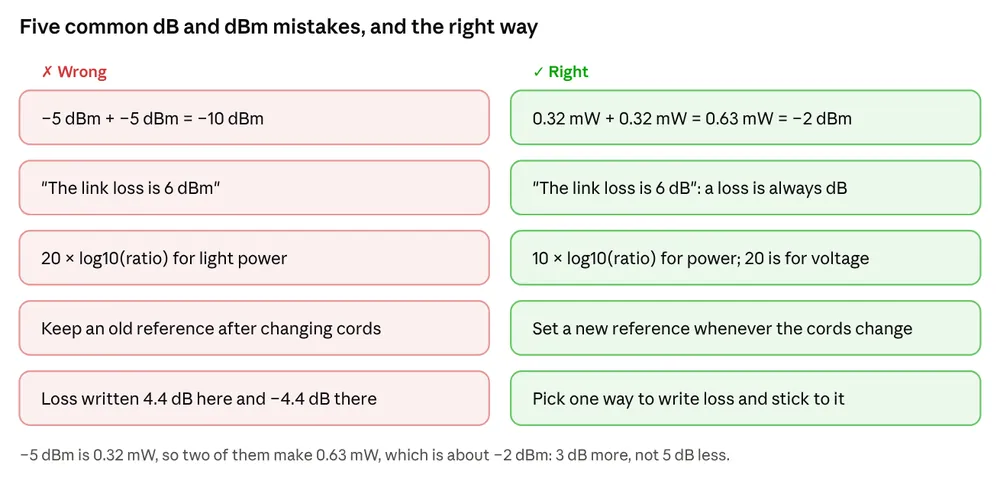
Why some formulas use 20 instead of 10. For voltage, the decibel formula is 20 × log10(V2 ÷ V1). That is because power grows with voltage squared. Light in a fiber is measured as power, so fiber loss always uses 10.
What does dBm mean? Power compared with 1 milliwatt
dBm uses the same formula, but it always compares your power with the same fixed amount: 1 milliwatt (mW). The “m” stands for milliwatt. Because the starting point never changes, a dBm number points to one exact amount of power. That is why it is called an absolute power level.
dBm = 10 × log10(P ÷ 1 mW) P (mW) = 10^(dBm ÷ 10)
mW to dBm, example. Your meter shows 0.25 mW. Divide by 1 mW and you still have 0.25. The log of 0.25 is −0.602. Times 10 gives −6.02 dBm.
dBm to mW, example. Your meter shows −17 dBm. Divide −17 by 10 to get −1.7. 10 to the power −1.7 is 0.02 mW, which is 20 microwatts (µW).
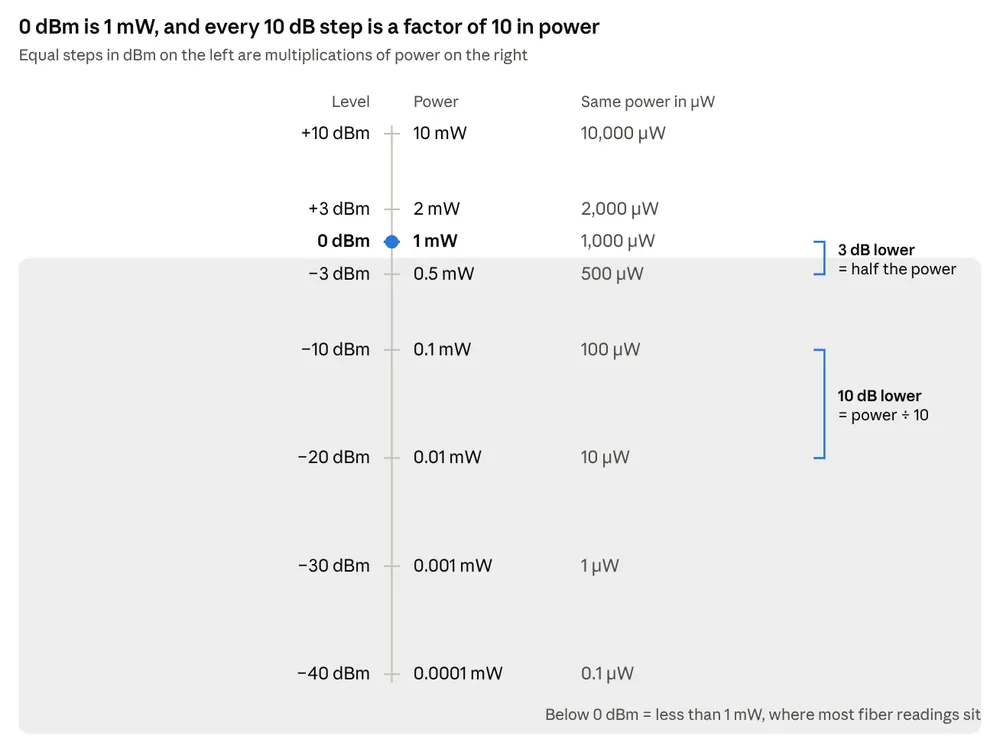
A negative dBm does not mean “negative power”. It just means less than 1 mW. Light in a fiber is usually weaker than 1 mW, so most fiber readings are negative dBm numbers.
Other units you may see. The letters after “dB” tell you the fixed starting point. dBW starts from 1 watt, so 0 dBW = +30 dBm. dBµV starts from 1 microvolt and shows up in radio and TV cabling. They are all absolute. Plain dB, with no letters after it, is always relative.
Absolute vs relative: dB vs dBm in practice
Ask yourself which question the number answers. “How much power is here?” That is absolute, so it is dBm. “How much did the power change?” That is relative, so it is dB. Most mistakes come from mixing the two.
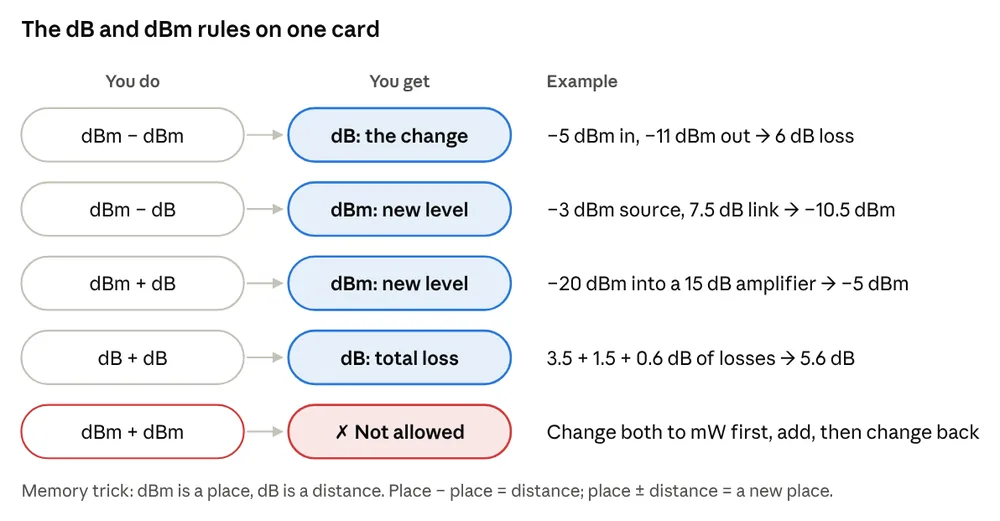
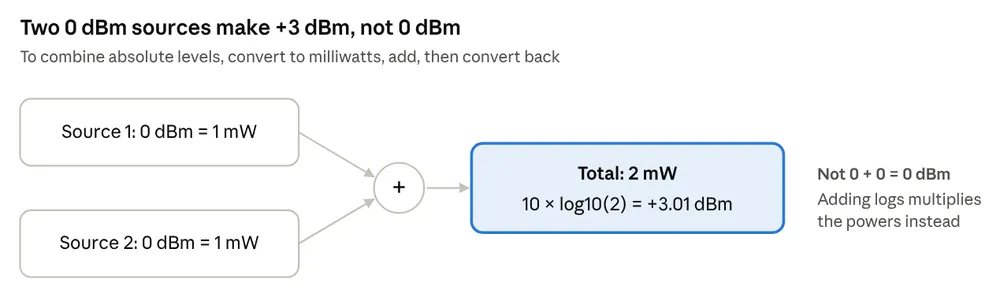
Why you can’t add two dBm numbers. Shine two lights of 0 dBm (1 mW each) into the same fiber. Together they make 2 mW, and 2 mW is +3.01 dBm, not 0 dBm. Adding the dBm numbers gives the wrong answer, because adding logs really multiplies the powers. Always change to mW first, add, then change back.
Absolute and relative modes on an optical power meter. In absolute mode, the meter simply shows how much light reaches it, in dBm. In relative (REF) mode, you first save a reading as your starting point, called the reference. After that, the meter shows how much lower each new reading is, in dB. That number is the loss of whatever you added between the source and the meter.
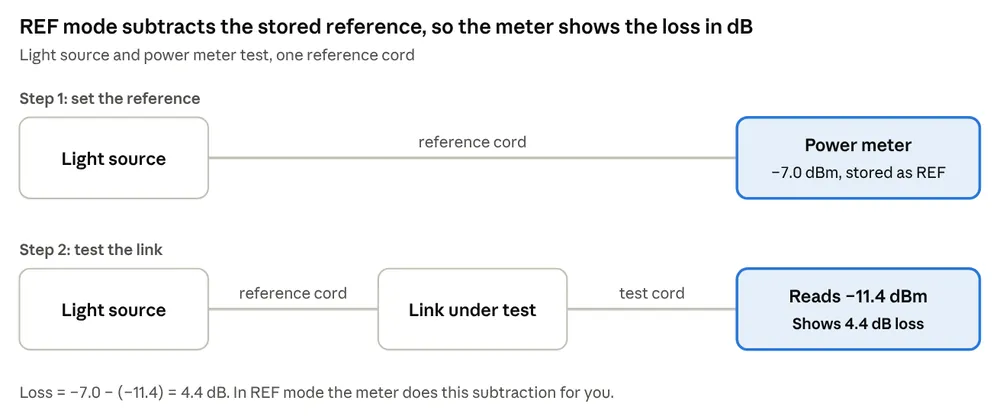
Some meters show the loss with a minus sign (−4.4 dB) because the power went down. It is the same loss, just written a different way.
Worked fiber examples: link loss budget and power budget
Every fiber calculation uses the same two moves: add up the losses in dB, then take that total away from a dBm level.
Example 1: a link loss budget (all in dB)
Imagine a 10 km single-mode fiber run between two buildings, tested at 1310 nm. It has a connector at each end and 4 fusion splices along the way. The industry standard TIA-568 sets the most loss each part is allowed to have. Add them up and you get the most loss the whole link may have and still pass.
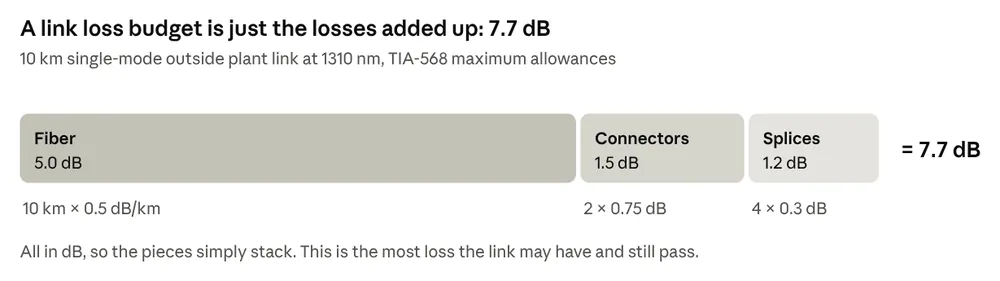
There is no dBm here yet, because a loss budget only says how much power is lost, not how much you started with.
Example 2: power budget and margin (dBm and dB together)
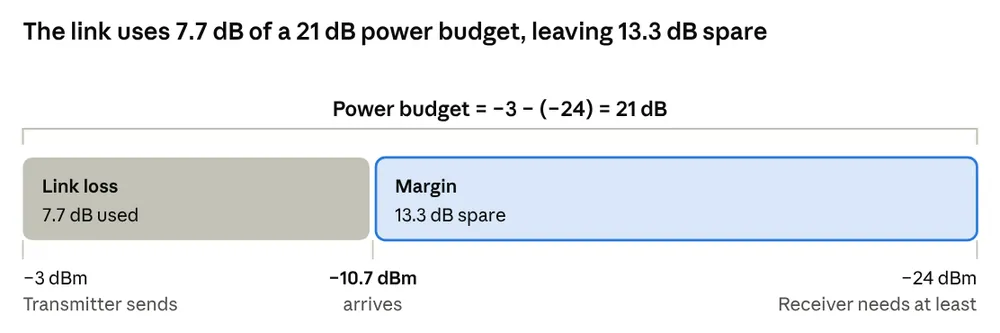
Now add the equipment. Say the data sheet for the optics says the transmitter sends −3 dBm and the receiver needs at least −24 dBm to work. These are example numbers; always check your own data sheet.
- Power budget = what the transmitter sends minus what the receiver needs: −3 − (−24) = 21 dB. This is the most loss the link can handle.
- Power at the receiver = −3 dBm − 7.7 dB = −10.7 dBm.
- Margin = the extra room left over: −10.7 − (−24) = 13.3 dB, or simply 21 − 7.7 = 13.3 dB.
The next picture follows the light along the link, part by part.
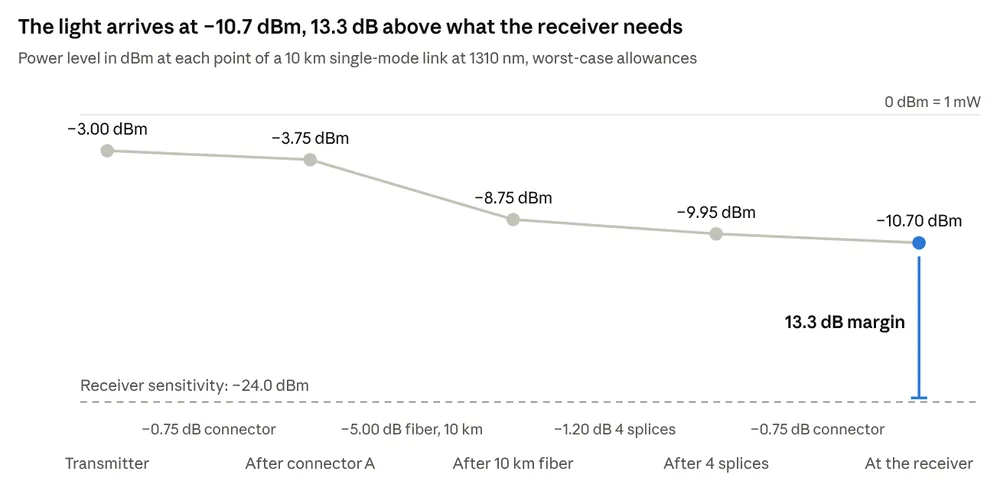
The line drops a little at each part of the link. The gap between the end of the line and the dashed line is your margin: the bigger the gap, the safer the link. Watch the other end too. On a very short link with a strong transmitter, the light can be too strong for the receiver, and you need an attenuator to turn it down.
Example 3: measuring insertion loss with a light source and power meter
- Connect the light source to the meter with a reference cord. Save that reading as your reference: −20.00 dBm.
- Now test through the link. The meter reads −26.30 dBm.
- Loss = −20.00 − (−26.30) = 6.30 dB. The budget from Example 1 was 7.7 dB, so the link passes with 1.4 dB to spare.
It does not matter how strong the test light is, because the reference step cancels it out. Only the difference counts. Write down how you set the reference (with one, two or three cords), because that decides whether the end connectors are counted in the loss.
Example 4: a short multimode link
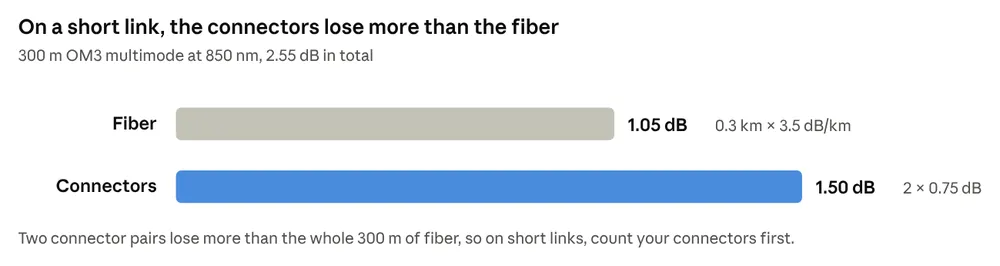
A 300 m OM3 multimode link at 850 nm with two connector pairs. Fiber: 0.3 km × 3.5 dB/km = 1.05 dB. Connectors: 2 × 0.75 dB = 1.5 dB. Total budget: 2.55 dB.
Common mistakes with dB and dBm
Free tools for this topic
Work out a link’s loss before you test it with our Fiber Link Loss Budget sheet, and record each fiber’s readings on the Fiber Cable Attenuation and Test Record. For the test methods behind these numbers, read fiber optic testing: OLTS vs OTDR, and for the tools see the fiber optic termination kit.
Sources
- The Fiber Optic Association, Guidelines on what loss to expect when testing fiber optic cables (TIA-568 loss allowances).
Written in our own words. The decibel and dBm formulas are standard engineering definitions.