
Data Center Tiers Explained: Tier I to Tier IV
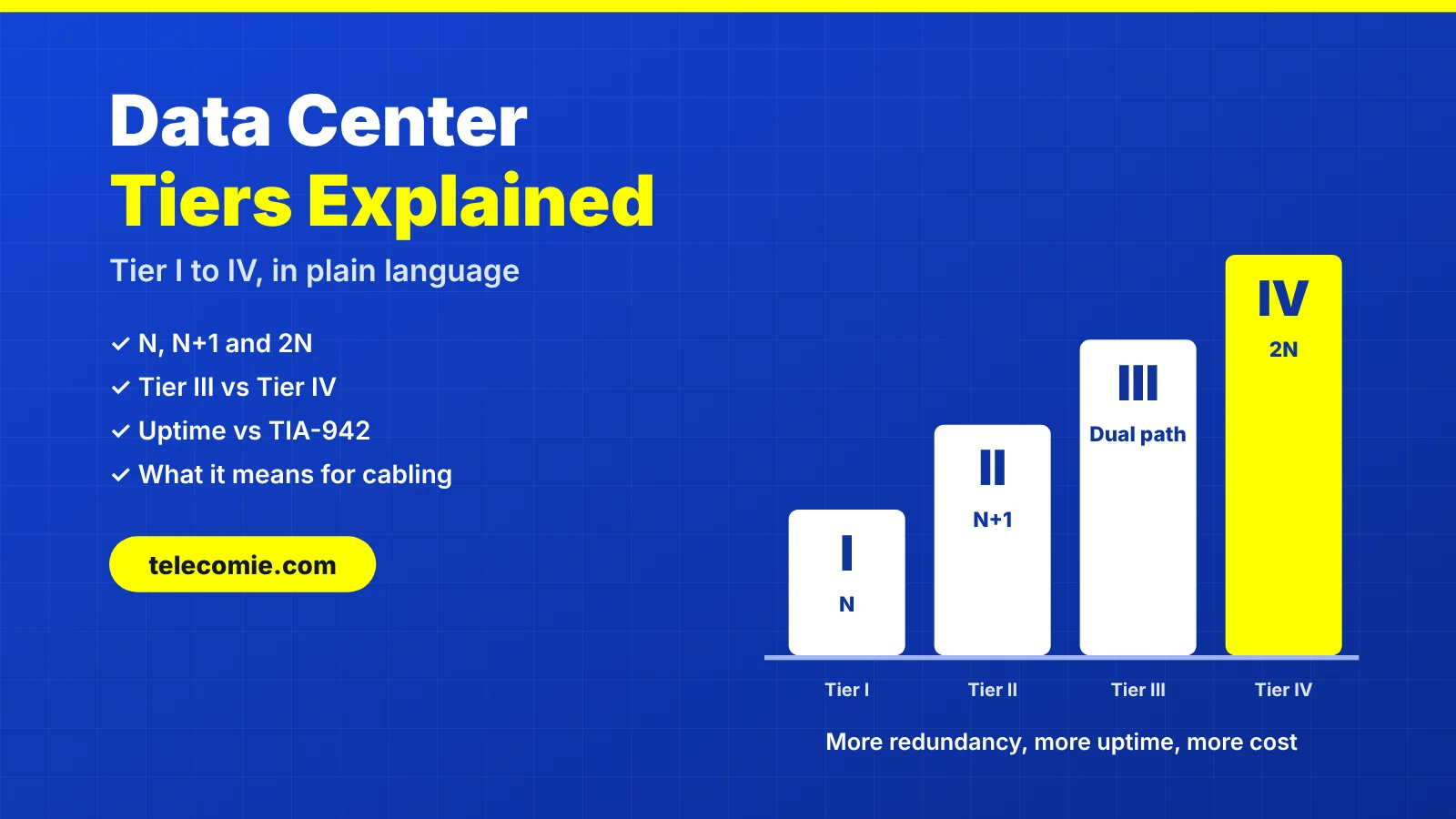
Data center tiers rate how well a facility keeps running when equipment fails or needs maintenance. There are four levels: Tier I has no redundancy, Tier II adds spare components, Tier III can be maintained without shutting down, and Tier IV keeps running even when a single fault occurs.
Key points
- The best-known system is the Uptime Institute Tier Classification (Tier I–IV). ANSI/TIA-942 uses a similar four-level “Rated 1–4” scale.
- The key words to remember: Tier III is “concurrently maintainable”, Tier IV is “fault tolerant”.
- Each step up costs significantly more to build and run, so the right tier depends on what an outage costs the business.
- Higher tiers affect cabling too: diverse entrance routes, redundant pathways and duplicated distribution areas.
The four tiers at a glance
| Tier | Short name | What it means | Typical redundancy | Commonly quoted availability |
|---|---|---|---|---|
| Tier I | Basic capacity | Single path for power and cooling, no spare components. Maintenance means a shutdown. | N | 99.671% (about 28.8 hours down per year) |
| Tier II | Redundant capacity components | Spare UPS modules, generators and cooling units, but still one distribution path. | N+1 components | 99.741% (about 22 hours per year) |
| Tier III | Concurrently maintainable | Two distribution paths. Any component can be taken out for maintenance without a shutdown. | N+1, dual paths | 99.982% (about 1.6 hours per year) |
| Tier IV | Fault tolerant | Fully independent, physically separated systems. A single failure does not affect the IT load. | 2N or 2(N+1) | 99.995% (about 26 minutes per year) |
The availability percentages are widely quoted industry figures, not certification criteria. A tier rating is about the design and how the site is built and operated, not a guaranteed uptime number.
What N, N+1 and 2N mean
- N: exactly enough equipment to carry the load. If 4 cooling units are needed, there are 4.
- N+1: one spare. With 4 needed, there are 5, so any one can fail or be serviced.
- 2N: a complete second system. With 4 needed, there are 8, in two independent groups.
- 2(N+1): two independent systems, each with its own spare. The highest level.
Tier III vs Tier IV: the difference that matters
Most enterprise and colocation facilities aim for Tier III. It allows planned maintenance on any part of the power and cooling systems without an outage, because there are always two paths and only one needs to be live.
Tier IV goes further. It survives an unplanned failure, such as a fire in one switchroom or a burst pipe, without affecting the IT equipment. To do this, the two systems must be fully independent and physically separated (compartmentalized), and switching between them must be automatic. This greatly increases cost, so Tier IV is usually reserved for facilities where even minutes of downtime are very expensive.
Uptime Institute tiers vs TIA-942 ratings
There are two well-known systems, and they are often confused.
| Uptime Institute Tier Classification | ANSI/TIA-942 | |
|---|---|---|
| Levels | Tier I, II, III, IV | Rated 1, 2, 3, 4 |
| Focus | Performance of power, cooling and operations | Full infrastructure standard, including telecom cabling, architecture, electrical and mechanical |
| Certification | Only by Uptime Institute | Through third-party conformity assessment bodies |
Only Uptime Institute can certify a facility as “Tier III” or “Tier IV”. A facility built to TIA-942 Rated 3 has a similar design goal, but it is a different scheme. When a provider claims a tier, ask which system it refers to and whether it is certified or just “designed to” that level.
What higher ratings mean for cabling
Tiers are mostly discussed in terms of power and cooling, but the telecom infrastructure must match. At higher ratings, expect:
- Two entrance rooms or entrance routes, with carrier cables arriving from different directions.
- Diverse pathways between the entrance room, the main distribution area (MDA) and the horizontal distribution areas, so one damaged route does not take down the network.
- Redundant main distribution, such as a second MDA, at the highest levels.
- Dual power feeds to every network rack, from separate distribution paths.
A Tier III power design with a single fiber route into the building is still a single point of failure.
Which tier do you need?
- Tier I–II: small server rooms and branch offices, where a planned shutdown once a year is acceptable.
- Tier III: most enterprise data centers and colocation sites. The usual balance of cost and resilience.
- Tier IV: financial trading, critical government and large cloud facilities, where downtime costs far more than the extra build cost.
Start from the business question: what does one hour of downtime cost? Compare that with the extra capital and running cost of each step up.
Free tools for this topic
Planning cable pathways for a data center? Use our free Conduit and Cable Tray Fill Calculator, and check fiber links with the Fiber Link Loss Budget sheet.
Sources
Tier definitions from the Uptime Institute Tier Classification System and ANSI/TIA-942; availability figures as commonly quoted in industry guides such as TechTarget. Written in our own words.